

Transfer Market Explained: How players are added to the platform.
If you’re a football fan, scout, agent, or even a curious observer of the beautiful game, chances are you’ve come across Transfermarkt. Known for its detailed player profiles, market values, transfer histories, and statistics, the platform has become one of the most trusted football databases in the world. But have you ever wondered how players actually get listed there?
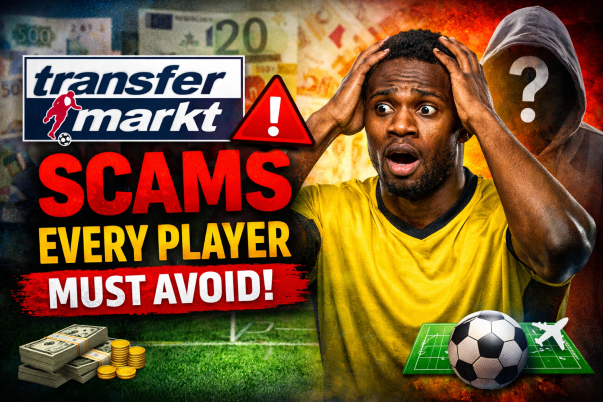
In today’s digital football world, Transfermarkt have become powerful tools for visibility. However, with opportunity comes risk. Thousands of young footballers, especially in Africa are being scammed by fake agents who use Transfermarkt as bait.
If you’re a footballer dreaming of going professional, this guide will protect you from costly mistakes.
-
What is Transfermarkt?
Transfermarkt is an online football database that provides information about players, clubs, transfers, fixtures, injuries, and market values. It covers leagues and players from all over the world, from elite professionals in top European leagues to young prospects in lesser-known divisions.
One unique thing about Transfermarkt is that it combines professional data with a strong community-driven approach. Much of its content is contributed and maintained by a global network of volunteers and moderators.
Transfermarkt is a public football database, not an agency, not a scouting platform, and not a company that signs players.
It provides:
- Player profiles
- Match statistics
- Market values
- Transfer history
How Players Actually Get on Transfermarkt
Adding a player to Transfermarkt is not random or automatic. There is a structured process in place to ensure accuracy and credibility.
-
Community Contributions
Transfermarkt relies heavily on registered users and volunteers. These contributors suggest new players, especially from lower leagues, youth academies, or countries that may not receive global media attention.
However, not every submission goes live instantly.
-
Minimum Requirements for a Player
Before a player can be added, they must meet certain criteria. Typically, a player must:
- Be part of a recognized football club
- Have participated in official matches (league, cup, or international)
- Be verifiable through reliable sources (match reports, club announcements, etc.)
Youth players can also be added, but usually only if they are part of a notable academy or have appeared in competitive fixtures.
-
Data Verification Process
Once a player is submitted, Transfermarkt moderators review the information. These moderators are experienced contributors with deeper access and responsibilities.
They check for:
- Correct spelling of the player’s name
- Date of birth and nationality
- Club affiliation
- Match appearances and statistics
- Reliable sources backing the information
If the data cannot be verified, the submission may be rejected or sent back for correction.
-
Moderator Approval
After verification, the player profile is approved by moderators and published on the platform. At this point, the player officially becomes part of the Transfermarkt database.
From there, the player’s profile can be updated over time with:
- Transfer history
- Market value estimates
- Injury records
- Performance statistics
-
Continuous Updates
Transfermarkt is constantly evolving. Players are updated regularly as they:
- Change clubs
- Improve performance
- Gain international caps
- Increase or decrease in market value
The community continues to play a major role here, with moderators ensuring quality control.
Why This Process Matters
The structured approach to adding players ensures that Transfermarkt remains reliable and credible. Since football data is used by fans, journalists, scouts, and even professionals in the industry, accuracy is essential.
By combining community input with strict moderation, Transfermarkt strikes a balance between wide coverage and trustworthy information.
Transfermarkt isn’t just a database—it’s a collaborative football ecosystem. The process of adding players reflects a careful blend of community passion and professional oversight.
Why Some Football Players Are Not on Transfermarkt
The only reason you’re not on Transfermarkt is because you haven’t played in recognized matches. It sounds simple—but in reality, there are several reasons why many players never make it onto the platform.
-
No Participation in Official Matches
The most common reason is exactly as stated: a player hasn’t played in officially recognized competitions.
Friendly matches, street football, or informal tournaments usually don’t count. Without official match records, there’s no verifiable data to build a profile.
-
Playing in Unregistered or Informal Leagues
Many talented players compete in local or semi-organized leagues that are not formally recognized by national football associations.
Since Transfermarkt relies on structured competition data, players in:
- Grassroots leagues
- Community tournaments
- Unregistered academies
may not meet the criteria for inclusion, even if they are highly skilled.
-
Lack of Verified Information
Accuracy is a major priority for Transfermarkt. If a player’s details cannot be confirmed through reliable sources, they won’t be added.
This includes:
- Full name and correct spelling
- Date of birth
- Club affiliation
- Match appearances
Without trustworthy documentation, moderators cannot approve the profile.
-
Youth Players Without Competitive Exposure
Not every academy player is listed. Many young players train at clubs but haven’t yet:
- Played in official youth leagues
- Featured in competitive fixtures
- Gained public recognition
Transfermarkt usually waits until there is verifiable match involvement before adding youth players.
-
Lower League Coverage Gaps
Although Transfermarkt covers a huge number of leagues worldwide, it doesn’t capture every single division equally.
Some lower leagues:
- Have limited media coverage
- Lack proper record-keeping
- Do not publish reliable match data
As a result, players in these leagues may be missing—not because they’re unimportant, but because their data is harder to verify.
-
Submission and Approval Delays
Transfermarkt is partly community-driven. Players are often added by contributors, then reviewed by moderators.
This means:
- A player might not yet have been submitted
- A submission could still be under review
- Corrections may be required before approval
So sometimes, it’s not that a player doesn’t qualify, they just haven’t gone through the full process yet.
-
Strict Quality Control
Transfermarkt prioritizes credibility over completeness. Instead of listing every possible player, it ensures that each profile is accurate and reliable.
This strict standard means some players are left out until:
- Their information is confirmed
- Their participation is clearly documented
- Their career reaches a verifiable level
Being absent from Transfermarkt doesn’t mean a player lacks talent or potential. In many cases, it simply reflects a lack of official exposure, documentation, or recognition within structured football systems.
The platform is built on verified data, and until a player steps into officially recorded competitions, they may remain off the radar.
So if you’re aiming to see your name there one day, the path is clear: play in recognized matches, build a record, and make your performances count where they can be seen and verified.
African Leagues Are Professional, So Why Aren’t Most Players on Transfermarkt?
The NPFL, Ghana Professional Legaue, and many other top African leagues are fully professional. Clubs are structured, players are contracted, and competitions are officially recognized.
Yet, a surprising reality remains: many players in these leagues are still missing from the Transfermarkt database.
This isn’t about professionalism; it’s about visibility, data, and structure.
The Reality behind the Gap
-
Data Is Not Easily Accessible
In many African leagues, match data is not consistently:
- Recorded in detail
- Published online
- Stored in centralized systems
Transfermarkt depends on verifiable information. Lineups, appearances, goals, and transfers. When this data is difficult to access, players are often left out.
-
Limited Digital Coverage
Top European leagues dominate global football media. Every match in leagues like the or is tracked in real time.
In contrast, many African leagues:
- Have fewer broadcast deals
- Lack detailed match reporting
- Receive limited global media attention
Less coverage means less traceable information.
-
Community Contribution Is Low
Transfermarkt relies heavily on contributors around the world. In regions with active contributors, leagues are well documented.
In many African countries:
- Fewer contributors are actively updating league data
- Player submissions are limited
- Some entries lack strong verification sources
This slows down player inclusion.
-
Verification Challenges
Before a player is listed, moderators must confirm:
- Identity and correct spelling
- Date of birth
- Club registration
- Match participation
In African leagues, inconsistencies in records or missing documentation can make verification difficult.
-
Poor Record-Keeping Infrastructure
Some clubs still operate without:
- Updated digital databases
- Official squad lists online
- Consistent statistical tracking
This creates a gap between the reality on the pitch and what is visible globally.
-
Focus on International Exposure
Transfermarkt tends to capture players who:
- Play in globally visible competitions
- Transfer between countries
- Attract scouting attention
Many African-based players are locally active and highly talented, but without international exposure, they remain underrepresented.
It’s Not About Quality
Let’s be clear: the absence of many African players on Transfermarkt does not reflect their ability or the professionalism of their leagues.
Africa continues to produce world-class talent. The issue is not talent, it’s documentation and global visibility.
The Way Forward
Improving representation on Transfermarkt and similar platforms will require:
- Better digital record-keeping by clubs and leagues
- Increased media coverage and broadcasting
- More local contributors updating player data
- Stronger collaboration between leagues and global databases
African leagues are professional, competitive, and full of talent. But until the systems that capture and share football data improve, many players will remain invisible on global platforms like Transfermarkt.
The game is being played. The talent is undeniable.
Now, it’s time for the data to catch up.
The Biggest Scam in Football Exposure: “Pay Me to Put You on Transfermarkt”
In recent years, a troubling phrase has been circulating among aspiring footballers especially across Africa:
“Pay me, and I’ll put you on Transfermarkt.”
It sounds tempting. For many players chasing visibility, opportunities, and recognition, being listed on feels like a big step forward.
But here’s the truth: this is a scam.
Why This Claim Is False
Transfermarkt does not charge players to be listed.
The platform works through:
- Community contributions
- Verified data submissions
- Moderator approval processes
No official agent, individual, or “connection” has the authority to guarantee a player’s inclusion in exchange for money.
If someone is asking you to pay for that service, they are misleading you.
How Transfermarkt Actually Works
To be listed on Transfermarkt, a player must:
Play in officially recognized matches
- Have verifiable data (club, appearances, competitions)
- Be submitted and approved by moderators
Even contributors who help add players:
- Do it voluntarily
- Cannot bypass verification rules
- Cannot guarantee approval
So paying someone does not give you any special advantage.
Why Players Fall for It
This scam thrives because of real challenges players face:
- Limited exposure in local leagues
- Lack of media coverage
- Desire to be seen by scouts and agents
- Confusion about how Transfermarkt works
Scammers take advantage of ambition and urgency, offering a shortcut that doesn’t actually exist.
What Really Happens When You Pay
In most cases, one of the following occurs:
- Nothing happens: The player is never added
- Temporary or fake listing: A profile may appear briefly but gets removed due to lack of verification
- Incorrect information: Wrong data is uploaded, damaging credibility
- Complete disappearance: The scammer vanishes after payment
Either way, the player loses money, and sometimes reputation.
The Real Way to Get on Transfermarkt
There is only one legitimate path:
- Play in officially recognized competitions
- Ensure your matches are documented
- Be part of a registered club
- Build verifiable records (appearances, stats, transfers)
- Get noticed organically or through proper submission
It may take time, but it’s real, and it lasts.
Protect Yourself and Others
If you hear anyone saying:
- “I have a connection inside Transfermarkt”
- “I can guarantee your profile if you pay”
- “Fast-track your name onto the platform”
Take it as a red flag.
Help spread awareness:
- Educate fellow players
- Call out false claims
- Encourage legitimate pathways
Transfermarkt is a data-driven platform, not a marketplace you can buy your way into.
Your talent, performance, and verified record are what matter, not shortcuts or payments.
In football, just like in life, anything that asks you to pay for credibility is usually taking it away from you.
Summary:
Profiles on Transfermarkt are created by data scouts and editors based on real football activity, not by agents or payments.
Players are typically added when they compete in recognized leagues or official competitions where their performances can be tracked and verified.
No agent, scout, or individual has special access to create a Transfermarkt profile in exchange for money.
Any request for payment to get listed is a scam.
Professional agents invest in players—they don’t exploit them.

https://shorturl.fm/39Ikz
https://shorturl.fm/f8ZbI
https://shorturl.fm/IZOvc
https://shorturl.fm/sqAwy
https://shorturl.fm/pLQ5i
Thanks for sharing, this helped me today.
I agree with your points here, nicely done.
https://addlinks.pro/l6q9X
Sports betting fans will fall in love with the odds here because they consistently beat the competition. I enjoy placing parlays on football and basketball with total confidence that my slips will be honored quickly. Big respect for the smooth operation here. Good luck to everyone xx999bet
Sports betting fans will fall in love with the odds here because they consistently beat the competition. I enjoy placing parlays on football and basketball with total confidence that my slips will be honored quickly. Big respect for the smooth operation here. Good luck to everyone xx999bet
https://addlinks.pro/t55R1